By Denys Medvediev
Transcription
Transcription software, explained
Every tool in the category, what they actually do, and an honest answer to which one you need.
Last updated: May 2026
Transcription software turns spoken audio into text. Three paths exist: Cloud (OpenAI, BYOK — best accuracy, audio leaves your machine), local Parakeet (5–10x faster than Whisper on CPU, English + 24 EU languages, audio stays on device), and local Whisper (99 languages, translate-to-English, 8 model sizes, audio stays on device). In Whisper by Remskill you press the hotkey, talk, release — the transcript appears at your cursor in any app. The local pipeline is free at signup, no card required.
The boring truth about accuracy (and the 95% trap)
Every transcription product on the internet claims accuracy in the 95–99% range. Notta advertises 98.86%. Happy Scribe sells a 99% human transcription tier. Our own homepage FAQ says local-mode accuracy "typically ranges from 95% to 99%." None of those numbers are lies. They are the wrong number, presented without the audio they were measured on.
Here is what the underlying research says. OpenAI's Whisper large-v3 is the model that more or less every modern transcription tool either uses, copies, or competes against. It reports a mean Word Error Rate of 7.44% on the public Hugging Face ASR leaderboard. On LibriSpeech-clean (studio-grade audiobook recordings) the same model hits 2.01% WER. On AMI, the standard meeting-room benchmark with overlapping voices and bad acoustics, the same model hits 15.95% WER. Same model. Same week. Eight times more errors on the worse audio.
That gap is the 95% trap. "95% accurate" in studio conditions can be 84% accurate in the meeting your boss called from a moving car. OpenAI's own model card spells this out in plain English: performance is uneven across languages, lower on low-resource ones, and varies by accent, age, gender, and demographic. NVIDIA says the same thing about Parakeet: 1.93% WER on LibriSpeech-clean, 11.31% WER on AMI.
So when you read an accuracy number on a marketing page, ask the question that vendor did not answer. On what audio. With what microphone. In what language. With how many speakers talking over each other. If the page does not say, assume it is the best-case number. Then assume your real audio is worse.
The boring truth is the most important upgrade you can make to your transcription accuracy is a microphone, not a model.
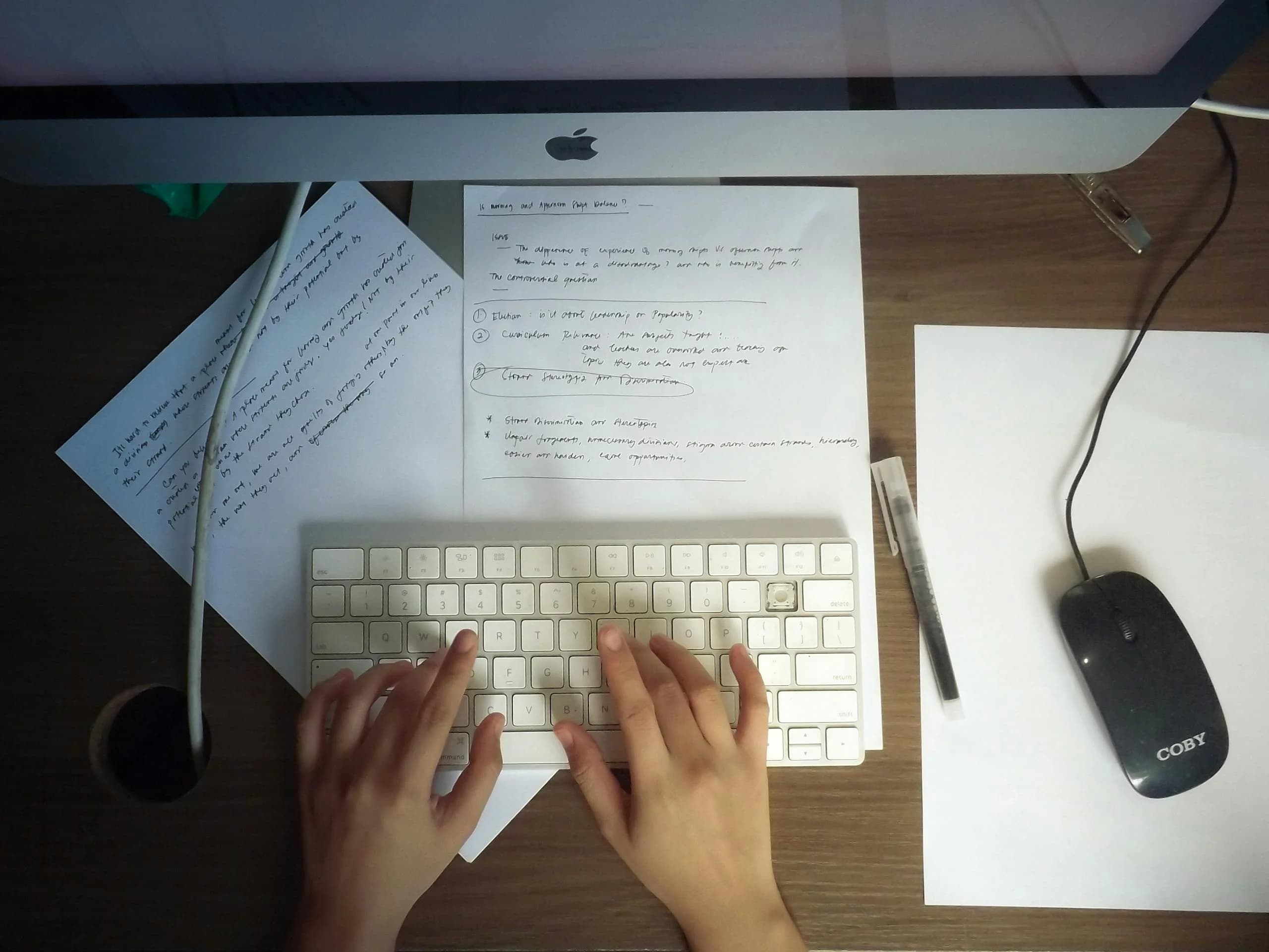
AI transcription vs. human transcription
Two kinds of transcription software exist in the world right now. They are priced like they are the same thing, which is the source of about half of the confusion.
AI transcription is the cheap and instant kind. You upload a file, or you dictate live, and a model returns text in seconds. Accuracy lands somewhere between 84% (a bad meeting) and 98% (a clean voice memo). Happy Scribe charges $0.20 per minute for top-ups on its AI plans. Our own Cloud mode bills you about $0.003 per minute directly through OpenAI. Otter, Notta, Trint, Descript, Jamie: every one of them runs on AI under the hood, often the same handful of models.
Human transcription is the expensive and patient kind. A person listens to your audio and types it out. Happy Scribe's human tier starts at $2.00 per minute. They advertise 99% accuracy with a four-hour-plus turnaround. Rev, GoTranscript, and a handful of others sit in roughly the same price band. The use case is real but narrow: court transcripts, medical depositions, anything where a 92% AI output containing the wrong drug name will land someone in court.
Most people reading this want AI. Use the table to be sure.
| If you have to transcribe… | Pick |
|---|---|
| Your own voice, in real time, into an email | AI dictation (any of the tools below) |
| A 60-minute interview with two speakers | AI batch transcription (Otter, Trint, Notta) |
| A legal deposition | Human transcription (Rev, Happy Scribe Human) |
| A medical document | Human transcription, full stop |
| A podcast you are about to edit | AI batch, then fix the names by hand |
| A multilingual lecture | AI with strong language support (Whisper multilingual, Happy Scribe AI) |
The mistake I watch people make is paying for human transcription out of fear. Then never reading the result because it shows up six hours later when they have already moved on. If the answer is going to be ignored by Tuesday, AI is fine.
Cloud vs. local: where your audio goes
Nobody wants to read this part and everybody should. Pick a transcription tool and audio of your voice (every word of it) ends up somewhere. The somewhere matters.
Cloud transcription means your audio leaves your computer. It goes to a vendor's server, gets transcribed by a model running on their hardware, and the text (and usually the audio) is stored long enough for you to retrieve it. Otter, Trint, Notta, Happy Scribe, Descript, Jamie, Wispr Flow: all cloud. So is our own Cloud mode, with one important wrinkle. In Cloud mode the audio is sent from your machine directly to OpenAI using your own API key. Whisper by Remskill is never in the middle, never sees the audio, never sees the transcripts. The vendor of record for your data is the company whose model you picked.
Local transcription means the audio never leaves your laptop. The model runs on your CPU or GPU. No network round-trip. No vendor logs. No "we may use your data to improve our service" clause. Apple Dictation does this for general text on supported Macs. Our own local modes (Parakeet and Whisper) do it on Windows and Apple Silicon Macs. Almost nobody else in this category ships pure local.
I once watched an internal team at a company I worked with rack up a five-figure cloud-AI bill in a quarter dictating standup recordings four times each. The prototype's "smart retry" was too aggressive. The CFO opened the dashboard during the next quarterly review. The room got very quiet. The point is not that cloud is expensive (it usually is not, at one user's volume). The point is that you do not always notice what leaves your machine until somebody asks you to account for it.
Most AI dictation apps you see advertised today are $30-a-month skins on the same OpenAI Whisper API call you could make yourself. They charge the cloud markup for software that mostly runs the model on their server and forwards the result to your screen. That model has been available since 2022. The expensive part is not the AI. The expensive part is the recurring subscription. If your audio is sensitive, or if your laptop is from the last four years and not doing much else, local is the honest choice.
That choice deserves its own breakdown, so our local vs cloud transcription guide spells out the accuracy, privacy, and cost trade between keeping audio on your machine and sending it to a server.
If that resonates, it is worth reading how offline speech-to-text desktop apps keep your voice on your own machine.
What Whisper by Remskill does (and what it doesn't)
Whisper by Remskill is our app. It is a desktop tool (Windows and Apple Silicon Mac) that puts speech-to-text behind a hotkey. You press the hotkey, talk, release, and the text appears at your cursor. It works in any app: email, Word, Slack, code editors, the browser address bar. The local pipeline is free for any authenticated user (Whisper, Parakeet, Ollama AI enhancement, history, presets, custom hotkey). No payment method required at signup. Pro adds Cloud features.
We ship three transcription paths. The app does not pick a default; you choose:
Cloud (OpenAI BYOK)
Latest OpenAI accuracy, plus web search. Transcription uses gpt-4o-mini-transcribe (about $0.003/min on your own OpenAI key) or gpt-4o-transcribe (about $0.006/min); enhancement uses gpt-5-mini by default. You bring the key, OpenAI bills you, we take no cut.
Parakeet (local)
NVIDIA's TDT model, about 600 MB, English plus 24 European languages, 5–10x faster than Whisper on CPU. Best pick if you mostly speak English and want fast local.
Whisper (local, 8 models)
The OpenAI open-source model family, 4 English-only and 4 multilingual sizes, from Base at ~140 MB to Large v3 at ~3 GB. 99 languages on the multilingual variants. The .en builds are English-only by design. Pick this when you need translation to English, low-resource languages, or finer per-recording control.
Transcription engine
Cloud
OpenAI · BYOKLatest OpenAI models, best-in-class accuracy, web access. Transcription via gpt-4o-mini-transcribe or gpt-4o-transcribe.
Parakeet v3
NVIDIA TDT · ~600 MB5–10× faster than Whisper on CPU. English + 24 European languages.
Whisper
Local · 8 models99 languages, translate-to-English, custom vocabulary. From Base (~140 MB) to Large v3 (~3 GB).
The default hotkey is Ctrl+Space on Windows and Command+Option on macOS, both customizable in Settings. The default AI activation keyword (when AI processing is on) is "Hey whisper". Local AI enhancement runs through Ollama at localhost:11434. Three performance presets (Fast, Balanced, and Accurate) swap beam size and voice-activity thresholds under the hood.
What Whisper by Remskill does not do: meeting bots. We do not join your Zoom, we do not summarise it afterwards, we do not chase calendar invites. One tool on your machine, one hotkey, a paste at the cursor. If you want a meeting notetaker, you want a different category. Read on.
A note on names, because this trips up almost everyone. Whisper-the-OpenAI-model is a free open-source speech recognition model released in 2022. Whisper by Remskill is our desktop app, which uses that model (among others). When someone online says "I use Whisper," half the time they mean the model and half the time they mean a product. Worth keeping straight when reading reviews.
The recording overlay, in three states
The pill appears at the bottom of your screen whenever Whisper is active. It stays out of the way and out of your apps.
Picking the right Whisper model for your hardware
Whisper — English
Fast model for quick English dictation. Good accuracy.
Best balance of speed and accuracy for English. Recommended.
Best accuracy for English transcription. Requires more resources.
6x faster than large-v3 with 99% accuracy. Best speed/quality ratio.
Whisper — Multilingual
Good balance of speed and accuracy for all languages.
Higher quality transcription for complex multilingual audio.
Best accuracy for professional multilingual use. Requires more resources.
Fast model with good accuracy.
The English variants (.en) are English-only — they run slightly faster and slightly more accurately on English audio than their multilingual equivalents. Pick multilingual only if you dictate in more than one language or need translate-to-English.
The Other Tools Worth Knowing
You will hit these names if you Google "best transcription software." I have used most of them, and a few I keep on hand for jobs ours does not do.
Otter.ai
Meeting-first. Their hero says "Turn meetings into transcripts" and that is the honest pitch. Basic is free with 300 monthly minutes; Pro is $16.99/user/month monthly (or $8.33/user/month annual) with 1,200 recording minutes; Business is $30/user/month. Six languages of AI transcription: English, Spanish, French, German, Japanese, Chinese. Pick this when the question is "what was said in the meeting I missed."
Trint
Editorial workflows. Pitched at journalists, the hero reads "From First Word to First Draft". Supports more than 40 languages for transcription and over 70 for translation. Strong on team collaboration and exporting clean drafts. Their pricing page moved around at the time I wrote this; I could not confirm the current per-seat number, so call sales if it matters.
Notta
Multilingual transcription, 58 languages supported, advertised up to 98.86% accuracy. Useful when your audio is in a language Otter does not handle.
Descript
Audio and video editing first, transcription second. 25 supported languages. Pricing climbs from a free tier through Hobbyist at $16/mo and Creator at $24/mo to Business at $50/mo. They describe their transcription as "automatic, with industry-leading accuracy & speed" and do not publish a number. Pick Descript when transcription is one step in a podcast-or-video edit.
Happy Scribe
The clearest split between AI and human in this category. AI from a 10-minute free trial up to 6,000 minutes/month, top-up at $0.20/min. Human tier from $2.00/min with 99% accuracy and four-hour-plus turnaround. 150+ languages for AI transcription, 80+ for AI translation, 65+ for human. Pick this when you want the choice in one bill.
Jamie
Meeting notetaker with a bot-free angle. Free tier at 10 meetings per month with a 30-minute cap; Plus at €21/mo for 20 meetings/2 hours; Pro at €39/mo for unlimited with a 3-hour meeting cap; Team at €33 per seat per month. Useful when company policy bans third-party bots on calls.
Sonix
Web-based AI transcription with strong embedding and subtitling. Often shortlisted alongside Trint for editorial teams.
Wispr Flow
The closest analog to what we do: hotkey-driven voice-to-text in every app. They support 100+ languages with auto-detection, advertise "4x faster than typing" at 220 wpm versus 45 wpm keyboard, and price Flow Pro at $12/user/month annual or $15/user/month monthly with a 14-day no-card trial. Free tier has a 2,000-words-per-week cap on desktop. longer comparison here.
OpenAI Whisper (the open-source model)
Not a product. A free model OpenAI released in 2022, six sizes (tiny, base, small, medium, large, turbo) with English-only variants on the smaller four and multilingual-only on large and turbo. Translation to English is built in via the --task translate flag. If you are technical and just want to transcribe an audio file from the command line, this plus ffmpeg is all you need. Whisper by Remskill, Wispr Flow, and a long list of other apps wrap this model so you do not have to.
Eight tools, swept. Almost everything else in this category is one of these companies rebranded, or one of these models in a smaller box.
If text-to-speech is what you actually need here is the honest free TTS roundup with the H1-vs-FAQ trick every "free" page hides.
When to Skip Every Tool on This List and Just Use Your Phone
Before you pay anyone anything, check what is already on your phone. iOS ships system-level dictation through Voice Control and the keyboard mic. Android ships Live Transcribe and Gboard voice typing. Both are free, no signup, work in every app, and the quality on modern phones is good enough for short text — we walked through the talk-to-text shortcuts on every device if you want the exact key combos.
If your job is "reply to a text while making dinner" or "write a 60-word note before this meeting starts," the phone is the right answer. Faster than opening a laptop, faster than logging into anything, no monthly fee. Apple's Mac Dictation is also worth a look. On supported Macs it processes general text on-device, dictates as long as you want without a fixed length cap, and stops itself after 30 seconds of silence. That silence timeout is the source of the persistent "Apple Dictation has a 30-second limit" myth: it is not the recording cap. Apple Dictation covers 62 language and regional variants today, which is more than most paid products.
Where the phone falls down is sustained dictation into desktop apps. You can dictate an email on your phone. You can dictate a 12-variant cold-email batch into your CRM from your phone. You will hate it. A desktop tool earns its keep there. Until then, the phone is free.
If most of your desktop dictation is email — specifically dictating Gmail replies on a laptop — there is a separate breakdown of the Chrome-extension path versus the system-app path that goes deeper than this article does.
Pricing
Most transcription tools want $20 to $50 a month. We charge less, and you can pay once.
The pricing landscape in this category sorts into four buckets. AI-only subscription tools (Otter, Trint, Notta, Descript, Jamie) sit in the $10 to $50 per user per month range, sometimes with a generous free tier capped by recording minutes. AI-plus-human services like Happy Scribe quote per-minute on top of a subscription; the human tier alone runs $1.90 to $2.00 per minute. Hotkey dictation tools (Wispr Flow, us) are priced like productivity software, single-user monthly or annual, sometimes with a lifetime option. Then there is the free option: Apple Dictation, Google Voice Typing, your phone's built-in keyboard mic. Zero per month for as long as Apple and Google ship those OSes.
The honest decision rule is not "what is the cheapest." It is "what is the recurring cost over the next three years for what I actually do?" A $20-a-month meeting tool you use twice a week is $720 over three years. A one-time lifetime purchase of a dictation tool you use daily is one bill. Multiply your monthly habit by 36 before you click subscribe. The math is rarely friendly to a subscription you use once a week.
Our current numbers (monthly, yearly, lifetime, team) live on the pricing page. I am not quoting them here because they change and the page is the source of truth.
The boring version of this article is that you already know what you need. Sustained writing all day? A hotkey dictation tool, local or cloud. One meeting a week? A meeting notetaker, monthly subscription. A single 90-minute interview? Pay $0.20 a minute to Happy Scribe and move on. A legal deposition? Hire a human. The non-boring version is that most people in this category are paying for the wrong product because the marketing pages are all written by the same three people. The honest move is to look at what you do this week, not what you hope you will do next month, and pick the tool whose hero copy describes that. The rest of it is noise.
Try it on your laptop
Download Whisper, hold the hotkey, watch the transcript appear at your cursor — in any app.
Local pipeline free at signup — no card required.
Reviewed May 2026 · Accuracy figures sourced from Hugging Face Open ASR Leaderboard and published NVIDIA Parakeet benchmarks.