By Denys Medvediev
Guide
Voice to text in Miro
Miro has no built-in dictation. The fix is a system-wide tool: press a hotkey, speak, and the transcript pastes at your cursor in any sticky note, text box, or comment. Your OS dictation works too, for short captures.
Last updated: June 2026
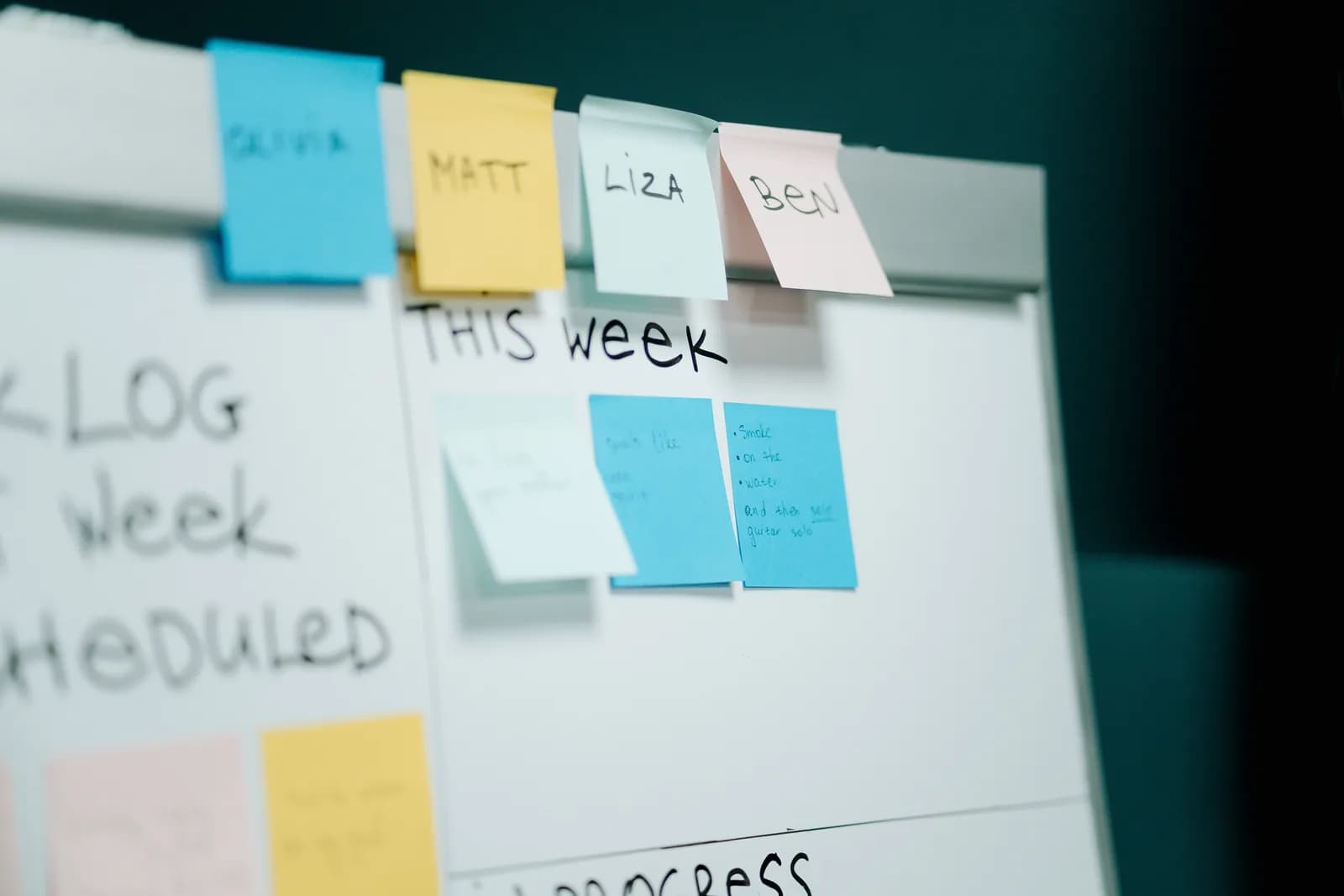
Voice to text in Miro works through a system-wide tool, not Miro itself. The Miro whiteboard has no built-in dictation. The fix is a tool like Whisper: press a hotkey, speak, and the transcript pastes at the cursor in any sticky note, text box, or comment. Your operating system's dictation works too, for short captures.
I run most of my brainstorming sessions on a Miro board, because a wall of sticky notes maps how I actually think better than a list ever has. The one thing I always wanted was to talk an idea onto a sticky instead of typing it into a box the size of a postage stamp. So I went looking for the microphone button. There is no microphone button. Miro does not have one, and after a fair bit of digging, I'm confident it isn't hiding one from me.
People search for "voice to text in Miro," find nothing in the app, and assume they missed a setting. They didn't. The setting was never built — there's an open community request asking for exactly this, and it's still open. The good news is the fix takes about two minutes, runs fully offline if you want it to, and works in every other app you open as a bonus.
Here's the thing most pages dancing around this keyword won't say plainly. A Miro sticky note is just a text box, the same as Gmail or a search bar. Dictation that pastes at your cursor doesn't care which app the cursor is in, or whether you're in the browser board or the desktop app.
So the real question isn't "how do I turn on voice typing in Miro." There's no switch. The question is "which dictation tool do I run on top of Miro," and the answer depends on whether you want free-and-built-in, or one offline hotkey that behaves the same everywhere. I'll walk through it, set one up in two minutes, show you how it feels to brainstorm by voice, and tell you when to skip the dedicated route.
Does Miro have built-in voice to text?

No. Miro has no built-in speech-to-text, dictation, or voice-typing feature for writing into a sticky note, text box, or comment by voice. There's no microphone button on a sticky, no voice command, no hidden preference. If you've been combing the toolbar for it, you can stop. It isn't there.
This isn't me guessing. There's a public idea on Miro's own community board titled "Writing with voice," asking for a tool that "transforms speech into text whenever triggered" for dropping ideas onto mind maps and stickies fast. It was posted in early 2023 and it's still an open request — no official ship date, no built-in feature on the other end of it. A couple of other community threads ask for the same thing in different words. The demand is clearly there; the feature isn't.
What does exist is Miro's AI, which can summarize or cluster text that's already on the board. That's useful, but it's not live dictation — it works on words you've already put down, not on words you're saying right now. You can't put your cursor in a sticky, talk, and watch the text appear. For that you need a tool that sits on top of Miro. There are a couple of honest ways to do it, and the rest of this guide covers them.
Press a hotkey, talk, text lands on the sticky
This is the whole mechanic, and it's boring in the best way. You press a hotkey, you speak, you release, and the transcript pastes at your cursor, in whatever text field has focus. Whisper holds a short tail after you let go of the key, so your last word doesn't get clipped. Because it pastes at the OS cursor, a Miro sticky note is just "any text box." Browser board or the Miro desktop app, same behaviour.
That's the part the landing pages overcomplicate. There's no integration to install into Miro, no API token to paste, no add-on to approve from a workspace admin. Your cursor is in a sticky, you talk, the words appear in the sticky. A small capsule shows up while you speak so you know it's listening:
The hotkey is the one thing worth getting right up front. On Windows it's Ctrl+Space; on Mac it's Command+Option, a modifier-only push-to-talk you hold while speaking. Both are changeable in Settings if they clash with something you already use. (My younger daughter once told me a hotkey "didn't work" in her drawing app. It was a conflict, not a bug, which is how I learned the average person has no idea what a hotkey conflict even is. So now every hotkey is customisable.) If you've ever set up dictation on Windows or on Mac, this is the same muscle memory pointed at a different app.
Set it up in two minutes (Windows or Mac)
You need a Mac on Apple Silicon or a Windows 10-or-newer PC, a working microphone, and Miro open in either the browser or the desktop app. The whole local pipeline is free for any signed-in account, with no payment method asked for at sign-up. Here's the sequence.
Step 1 — Install Whisper and sign in.
Download from the download page, install, and create a free account. No card. The whole local transcription pipeline opens right away.
You'll know it worked when the app's tray icon appears and the setup wizard offers to pick a model.
Step 2 — Pick a transcription path.
The app doesn't choose for you. You get three: Cloud (OpenAI, bring your own key), Local Parakeet, or Local Whisper. For a brainstorm where ideas land on shared stickies, start local — more on that two sections down.
You'll know it worked when a model finishes downloading and shows as ready.
Step 3 — Confirm your hotkey.
Windows defaults to Ctrl+Space, Mac to Command+Option held as push-to-talk. On Mac, grant the Accessibility permission when prompted; without it, the paste-at-cursor can't reach your browser or the Miro desktop app.
You'll know it worked when a test recording pastes into any text field.
Step 4 — Double-click a Miro sticky and talk.
Open your board, double-click into a sticky note (or a text box, or a comment) so the cursor is blinking, hold the hotkey, say a sentence, release. The transcript appears where the cursor is.
You'll know it worked when your spoken sentence is sitting on the Miro sticky as text.
The slow part is the model download, not the setup. Everything else is the four steps above. Once it's running, getting an idea onto the board stops being a typing task and starts being a talking task — which, for a brainstorm, is the whole point.
Sticky notes, text boxes, and comments by voice
Miro gives you a few places to put words: the sticky note, the free text box, the comment thread, and shape labels. They behave a little differently, but for dictation they're all the same animal — a field with a blinking cursor. The rule is simple. If you can see a text cursor, you can dictate into it. Double-click a sticky and the cursor appears; hold the hotkey; the words land. Same for a text box, same for a comment.
The one habit worth building is putting the cursor where you want the text before you start talking, not after. Dictation pastes at the cursor, so if you start a recording while nothing's focused, the text has nowhere to go. With a sticky, that means a clear double-click first. It sounds obvious written down. It's the single thing people forget on their first try, me included, on a board where I'd clicked empty canvas instead of the note.
Because the same hotkey works in every field, the flow doesn't change when you move around the board. The key that fills a sticky also fills the comment you leave on a teammate's frame, and the same key fills your Gmail compose box and a commit message once you tab away from Miro entirely. One tool, every text field, on both Windows and Mac. You don't relearn anything when you switch apps.
Local or cloud: which mode for a brainstorm
For Miro, local mode is a fine default. A brainstorm is usually rough, fast, half-formed — exactly the kind of text that doesn't need a cloud round-trip to capture. Local also runs fully on your machine, which matters if the board is internal strategy you'd rather not route through anyone's server on the way to a sticky. If your Mac is Apple Silicon or your PC is from the last few years, local handles everyday idea-dumping without complaint, and cloud becomes the escape hatch rather than the default.
Here's how the three paths differ, because the app makes you pick and I'd rather you pick well:
- Local Parakeet — NVIDIA's TDT engine, around 600 MB, and the fastest local option — 5 to 10 times faster than Whisper on CPU. Covers English plus 24 other European languages, 25 in total. No translate-to-English. If you brainstorm in English or another European language, this is the quick, fully offline pick — and speed matters when ideas are flying.
- Local Whisper — slower than Parakeet on the same machine, but the multilingual builds cover 99 languages and can translate to English. The English-only builds are English-only, not 99. Pick this for Chinese, Japanese, Korean, or any translation work, which Parakeet can't do. Default English model is around 480 MB.
- Cloud (OpenAI, BYOK) — best accuracy and web access, using your own OpenAI key billed straight by OpenAI. Transcription runs on gpt-4o-mini-transcribe by default. Needs internet, so it's the one path that leaves your machine. The Cloud surface is part of Whisper Pro.
The boring truth is that for the kind of text most people put on a Miro board, local is plenty. Both local engines run fully on your machine with nothing sent to a server. Cloud earns its place when you want top-tier accuracy on a hard recording or you need the model to pull a fact off the web mid-sentence. For a brainstorm habit, start local and only reach for cloud when local leaves you wanting.
Brainstorm by voice and let AI tidy the dump
Raw dictation comes out as a run-on. You say "okay so for the launch we need email landing page demo video and someone to own the analytics dashboard," and that's the unpunctuated wall any speech engine hands you. On a sticky, that's actually fine — a brain-dump is allowed to be messy. But when you want it readable, cleaning it up is where the paths diverge.
Windows Voice Typing adds punctuation as you speak, and macOS Dictation handles basic punctuation when you say "comma" or "period." For heavier cleanup — stripping the "ums," fixing the run-ons, turning a spoken paragraph into something you'd actually keep on the board — Whisper can run an AI pass. Say the activation phrase "Hey whisper" and the text gets enhanced before it lands. On a local model that runs through Ollama; in cloud mode it's gpt-5-mini by default.
okay so for the launch we need email landing page demo video and someone to own the analytics dashboard um before friday
For the launch we need: email, landing page, demo video, and someone to own the analytics dashboard — all before Friday.
The honest limit is the same one Logseq users and Notion users run into: voice gets you the words, but it doesn't arrange your board. No dictation tool drops five separate stickies in a neat grid because you paused between thoughts; it pastes text into the one field your cursor is in. Anyone promising "say five ideas and watch them spread across the canvas" is selling you a demo, not a Tuesday. The realistic flow is fast and good enough: double-click a sticky, dictate the idea, hit Escape, double-click the next sticky, dictate the next one. The talking is the fast part. The clicking between stickies is the part you still do by hand — and it's quick.
That same speak-then-clean flow pays off well beyond the board — you can also dictate clean prose into any app with the one hotkey, so a long meeting recap becomes a few spoken sentences instead of a paragraph you type out.
When to skip a dictation tool for Miro

Sometimes the right tool is the free one already on your machine, and pretending otherwise would be dishonest. If you only drop short captures onto a board — a two-word sticky, a quick comment — your operating system covers it for nothing.
On Windows, press Windows key + H and the built-in Voice Typing bar opens wherever your cursor is, a Miro sticky included. It punctuates on its own and is fine for short bursts. The catch: it routes through Microsoft's servers and needs an internet connection, so it isn't an offline option. On Mac, Dictation lets you speak to enter text anywhere you can type, set up in System Settings under Keyboard, and on Apple Silicon general text can be processed on-device. For a single sticky or a quick comment, either built-in is genuinely enough, and I'm not going to tell you to install an app for a two-word reminder.
Reach for a dedicated, system-wide tool when the built-ins start hurting: long stickies, a whole brainstorm dumped fast, multilingual work, offline privacy on Windows, or wanting one hotkey that behaves the same in Miro, your email, and your editor. Below that bar, use what's free. The dedicated tool earns its place when you're filling a board, not jotting one note.
The same trade-off shows up if your work spills into a tracker — the logic in dictating into Jira is identical, because there too the cursor, not an integration, is the real way the text gets in.
Further reading
Miro never shipped a microphone button, and given the request has sat open since 2023, I'm not holding my breath. It doesn't need to, because the cursor is the integration. Talk into the sticky, get text, click to the next one. I dictated most of this guide into a text box that wasn't Miro, with a tool that doesn't care which box it is, then dropped the outline onto a board to see how it scanned. That's the whole trick.
Try it on your next Miro board
Double-click a sticky, hold the hotkey, talk, release. The transcript lands where your cursor is — and in every other app too.
Free local mode for any signed-in account. No card required to start.